Eli's serial-attack conspiracy exposed
How to Flirt with A Naked WerewolfEli's serial-attack conspiracy exposed is the decisive revelation that reinterprets Grundy's wolf-attack crisis as a calculated political campaign rather than a series of uncontrolled animal attacks. In the climactic confrontation, Eli admits that he manipulated a rival pack, exploited Cooper's guilt, arranged attacks on humans, and used public fear to weaken Cooper's position. The disclosure also reveals how the secret rules of the werewolf pack constrained Eli's direct action while enabling him to make Cooper's life increasingly dangerous by indirect means.
The Political Background
Eli's conspiracy grows out of the struggle for leadership within the werewolf pack. Cooper explains that, after becoming alpha, he faced an invasion from a pack led by Jonas, whose group had been driven from its former territory and sought the hunting grounds of Crescent Valley. Jonas had studied the valley's vulnerabilities, the village's layout, and the number of available fighters before threatening Maggie's life in an attempt to force Cooper to surrender control. Cooper's eventual defense of his family killed all twelve members of the invading pack. Although the pack praised him as a strong leader, Cooper experienced the victory as a moral catastrophe: he believed that he had killed people, not merely animals, and withdrew from his family because he could not trust himself or accept the authority others celebrated.
That withdrawal created the opening Eli wanted. The pack's system treated the alpha as the leader responsible for major decisions, family welfare, and protection from threats such as wild animals and criminals. Eli understood that Cooper's moral hesitation could be presented as weakness, while Eli's own willingness to use violence could be presented as strength. He therefore sought not simply to replace Cooper temporarily, but to make Cooper's return impossible and establish himself as the leader the pack could no longer disregard.
The Coup and the Manufactured Crisis
Eli began by supplying information to the rival pack for months, helping its members stage an assault that he could later pretend to discover alongside everyone else. Their operation failed, but it achieved the immediate objective of removing Cooper from the valley. Eli then occupied the vacant position by presenting himself as the reluctant protector of the community. He comforted the pack, cultivated Maggie’s resentment, and told her that Cooper had abandoned her while Eli would never do so. The performance was calculated rather than compassionate: he regarded Maggie’s confidence and adolescent complaints as tedious, yet used her trust as a political instrument. When the pack continued hoping for Cooper’s return instead of granting Eli the authority he believed he deserved, he concluded that temporary displacement was insufficient and began seeking a permanent solution.
The Serial Attacks and Their Hidden Purpose
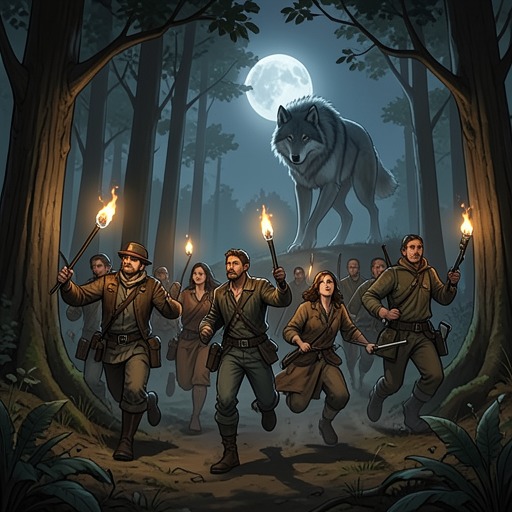
Eli’s next strategy was to turn Grundy’s fear of wolves into a weapon against Cooper. He arranged attacks on selected humans, including a hiker and an old woman, hoping that frightened residents would form an armed response against the wolf Cooper represented. He also followed Mo during her camping trip, apparently looking for an opportunity to seize her, but abandoned that immediate plan because Cooper never left her side. Abner’s presence near the campsite gave Eli an easier target: he attacked the older man, who fought back despite his age, then relied on Cooper’s incomplete wolf-state memory to make the killing appear to be Cooper’s responsibility. Cooper could not remember leaving the sleeping bag or transforming that night, and Abner’s terror suggested that the injured man had recognized the attacker as the creature that had mauled him.
The same campaign implicated Eli in the attack on Susie Q and in the deaths of the hikers whose bones were scattered away from their campsite. Each incident served two purposes at once. It produced genuine victims while reinforcing the story that an uncontrolled wolf was preying on the human community, and it exploited Cooper’s own reluctance to trust his instincts. Because Cooper already believed that his poor recall and violent capacity made him dangerous, Eli could allow him to absorb blame without directly accusing him. The conspiracy therefore operated through psychological pressure as much as physical violence: it made Cooper doubt his identity, endangered the people closest to him, and encouraged the townspeople to treat him as the source of the crisis.
Eli’s confession also exposes the restriction that prevented him from attacking Cooper openly. As alpha, Cooper was protected by a biological imperative that barred Eli from harming him unless Cooper attacked first. Eli treated this prohibition not as a moral boundary but as a tactical problem. He could not strike the alpha himself, yet no rule prevented him from engineering circumstances that would isolate, incriminate, or weaken Cooper. By provoking human hostility and threatening Mo, Eli attempted to force Cooper into a protective response that might finally permit direct violence. Mo’s pregnancy made the pressure more effective: Eli recognized that Cooper would be even less willing to abandon her, and he regarded her unborn child as the leverage that had compelled him to escalate.
Exposure and Consequences
The conspiracy becomes undeniable when Eli reacts with fury to the killing of a real wolf, revealing that the carcass has destroyed a staged operation rather than solved a natural crisis. His transformation, yellow eyes, and attack on Mo turn political confession into immediate physical danger. He explains that he had spent years cultivating the image of a leader while regarding Cooper as the only obstacle between himself and the authority he believed he deserved. His account also clarifies why the attacks were so difficult to trace: he could not directly harm the alpha because of a biological prohibition, but he could manipulate rivals, humans, and frightened neighbors into making Cooper vulnerable. The rule that supposedly protected Cooper therefore became, in Eli’s hands, a framework for indirect warfare.
Eli’s admission revises the meaning of the earlier violence. The assault on Mo by John Teague, her recurring bodily memories of the brick wall and blood, and her later panic when returning to the alley establish how human violence leaves its own traumatic residue; Eli’s campaign adds a second layer in which fear is deliberately cultivated and redistributed through the town. The attacks on Susie Q, the hikers, and Abner were not isolated expressions of wolf instinct. They were instruments in an effort to produce an angry human hunting response, sever Cooper from the community, and make his protective instincts appear to confirm the accusation against him. Abner’s unloaded rifle, the deep claw marks near his neck, and Cooper’s inability to remember transforming near the campsite become evidence of both the campaign’s brutality and its psychological design.
The exposure also forces a moral distinction between Cooper’s earlier massacre and Eli’s violence. Cooper had killed all twelve members of Jonas’s invading pack while defending Maggie and the valley, then treated the act as an unforgivable personal failure despite his family’s praise. Eli instead treats the killing of humans as a means to power, disguising calculated aggression as protection and using other people’s grief as political material. Mo’s refusal to let Cooper torture himself with guilt after Eli’s defeat provides the immediate ethical counterpoint: defensive violence may still wound the person who commits it, but Eli’s attacks are condemned by their deliberate manufacture of victims, their exploitation of trust, and their pursuit of domination. The conspiracy’s exposure thus clears Cooper of the serial attacks while leaving the larger question of violence unresolved; it reveals that the danger was not simply the wolf within him, but the leader who converted the pack’s rules, family loyalties, and human fear into a campaign for control.